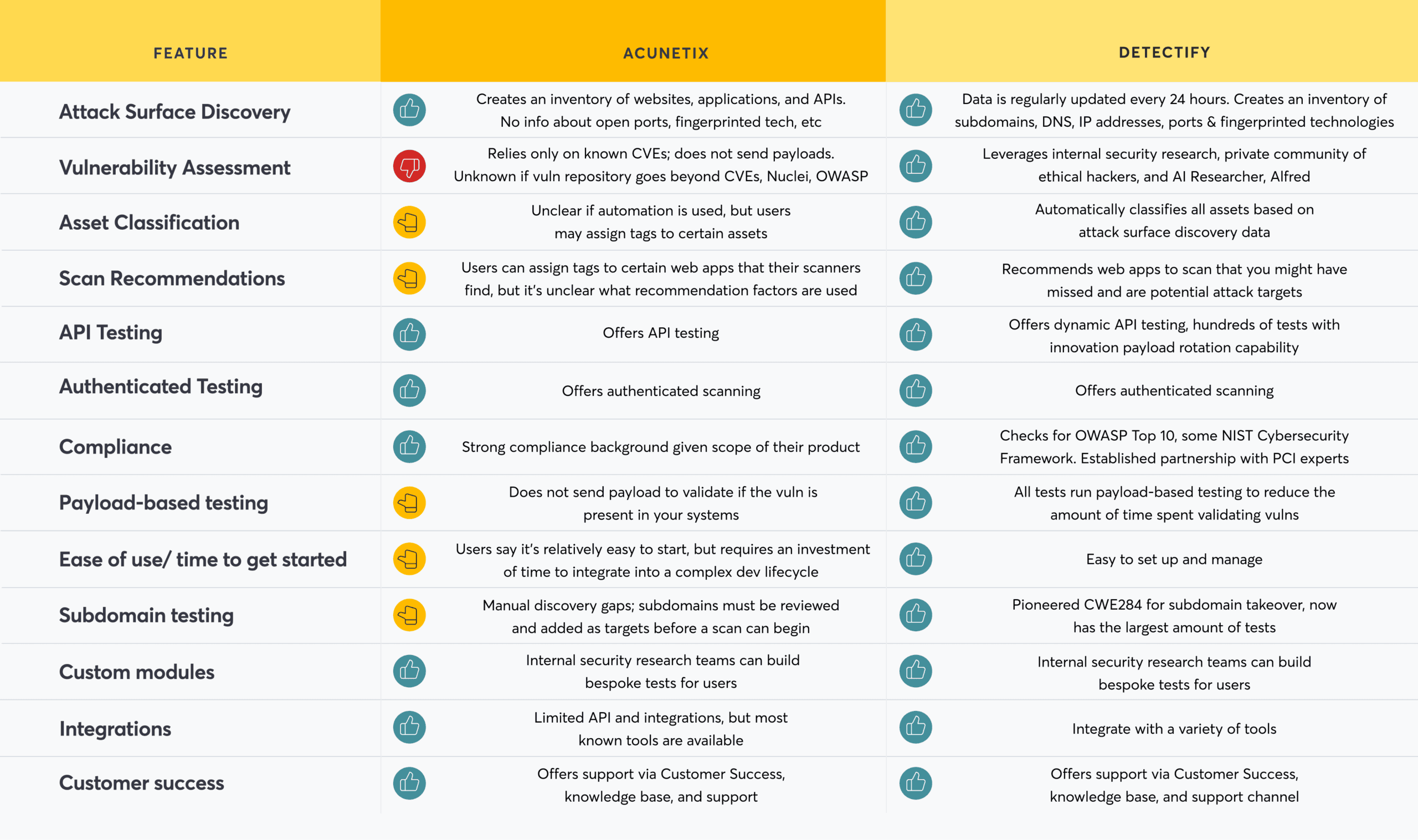
The section below summarize the key pros and cons of Acunetix vs Detectify to help AppSec teams quickly evaluate which DAST tool best fits their security and operational requirements
Acunetix
Pros
- Provides deep visibility into the application’s backend, pinpointing the exact line of code that needs fixing.
- Strong at crawling traditional architectures and specialized platforms like WordPress.
- Offers a Windows/Linux installation for teams.
Cons
- Discovery is a separate step; identified subdomains must be manually reviewed and promoted to “Targets” before they are actually scanned.
- Setting up authenticated scans and managing complex login sequences often requires significant manual supervision and technical expertise.
- As a broad scanner, it can produce a high volume of findings that require manual triage to filter out false positives.
Detectify
Pros
- It delivers high-fidelity, low-noise findings by using 100% payload-based testing, which confirms exploitability and reduces manual triage time.
- Its vulnerability intelligence is continuously enhanced by a private community of 400 ethical hackers, enabling the discovery of novel and zero-day vulnerabilities.
Cons
- It is focused on the external attack surface; however, internal scanning capabilities are under active development.
- It does not offer a self-service feature for advanced engineers to write and run their own custom scan logic or vulnerability templates.
In-depth comparison: Visibility and Discovery
Acunetix assumes you already know what you need to scan. It is built as a target-based scanner where you provide the URL, and it goes to work. Acunetix’s focus remains on the bottom-up approach; once a target is identified, it crawls every corner. For teams with a strictly defined and static perimeter, this works really well. However, it often misses the shadow IT created by developers spinning up staging environments or marketing teams launching microsites.
Detectify treats discovery as a continuous, automated process. It doesn’t wait for you to tell it what to scan; it uses an outside-in approach to map your entire attack surface. It identifies subdomains and IPs that you might have missed. Detectify can provide intelligent scan recommendations, highlighting newly discovered high-risk assets and ensuring your security coverage grows as quickly as your infrastructure. Acunetix is a spotlight, shining brightly on whatever you point it at, however Detectify is a floodlight illuminating the entire room, providing visibility into subdomains, forgotten assets, and the broader external attack surface.
In-depth comparison: Assessment Methodology
Acunetix is known for IAST (Interactive Application Security Testing) technology. By placing an agent inside the application, it can see the source code being executed. This allows it to pinpoint the exact line of code where a vulnerability exists. It is exceptionally strong at finding vulnerabilities in legacy applications and complex CMS platforms like WordPress. However, because it relies heavily on these internal signatures, it can sometimes produce noise that requires manual triage, therefore taking more time and maintenance.
Detectify takes a “hacker-first” approach. Instead of just looking for signatures, it uses 100% payload-based testing, executing non-destructive attacks to see if a vulnerability is actually exploitable. Much of its security logic comes from its Crowdsource community, with more than 400 elite ethical hackers who provide Detectify with novel exploits and 0-days long before they hit a CVE database. This is paired with Alfred, an AI security researcher that converts new vulnerability disclosures into assessments fully autonomously. Acunetix helps developers find the line of code to fix. Detectify tells you exactly how an attacker would break in, often using flaws that haven’t been publicly documented yet.
In-depth comparison: Usability and Triage
Acunetix offers a high degree of granular control and for users who need to customize every scan parameter or deploy the tool on-premise to reach internal networks, Acunetix is the go-to. However, this flexibility requires significant configuration. Setting up authenticated scans and managing the volume of findings can be a full-time job for an AppSec engineer.
Detectify is built for modern, fast-moving teams that don’t have time for manual triage. It prioritizes a low signal-to-noise ratio. Because vulnerabilities are payload-verified, the findings are delivered with high confidence, a low false positive rate and reproducible evidence. This allows security teams to automate the workflow: Detectify finds it, verifies it, and pushes it directly into Jira or Slack, allowing the engineer to act as a facilitator rather than a manual tester. Acunetix is a powerful manual tool for the deep-dive specialist. Detectify is a streamlined automation engine for the team that needs to scale.
Conclusion: Which product should I choose between Detectify and Acunetix?
The core difference between Acunetix and Detectify is based on your team’s approach to application security and attack surface management. Acunetix offers a toolset that is ideal for teams needing deep technical insights on a fixed set of applications and an understanding of what domains are under their purview. In contrast, Detectify is a DAST solution that uses 100% payload-based testing, allowing security teams to stay ahead of emergent threats. While Acunetix is a good fit for organizations requiring on-premise deployments, Detectify’s payload-based engine and Detectify Crowdsource community deliver a high-fidelity signal of confirmed, exploitable findings. This allows AppSec teams to bypass the noise of theoretical CVEs, find novel, non-CVE flaws, and focus on remediating the vulnerabilities that actually matter across their entire attack surface.
Ready to see your attack surface from the outside in? Start a 2-week trial or book a demo.
If you’re interested in our product comparison series, here are a few more.